
How do driveway bollards work? As an engineer specializing in road safety, I often remind clients that residential driveway bollard systems are fundamentally different from commercial crash rated automatic bollards. Commercial systems are designed for extremely high impact resistance and frequent operation, whereas residential driveway bollards simply need to be convenient for everyday use. We design crash rated automatic bollards and driveway automatic bollards to meet these different needs.
Below is a technical explanation of how automatic driveway bollards operate in residential applications.
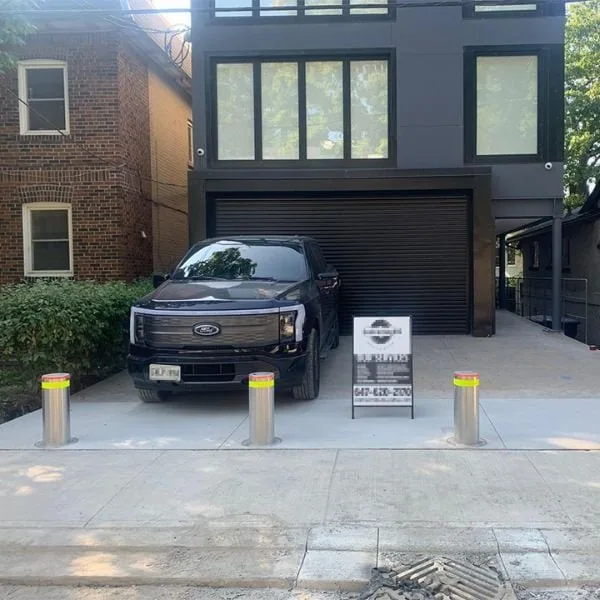
1. Core Drive Mechanisms: How Retractable Bollards Rise and Lower
Unlike manual retractable bollards, automatic driveway bollards rely on powered actuators for effortless, hands-free operation. Homeowners can raise and lower the posts via a mobile app, remote fob, or smart home automation.
Integrated Electromechanical Drives (Residential Industry Standard)
Modern residential driveway bollards typically utilize a compact electromechanical actuator mounted directly inside the bollard’s inner cylinder.
Lead Screw Assembly: An electric motor drives an internal worm gear or lead screw (spindle). As the motor rotates, it drives a heavy-duty nut along the thread, raising the inner cylinder upward or retracting it flush with the road surface.
Engineering Advantages: Electromechanical systems operate cleanly with zero risk of hydraulic fluid leaks contaminating paved or resin-bonded driveways. They run quietly, offer high reliability for typical home usage (10 to 50 cycles per day), and hold their position securely even during a power outage.
Engineering Disadvantages: They generally have a slightly shorter continuous service life compared to heavy commercial hydraulic systems under continuous high-traffic conditions.
Compact Hydraulic Actuators (For Heavy-Duty Applications)
For extra-wide driveways or heavier stainless steel rising bollards, compact hydraulic units are used. These self-contained designs do not require a separate external pump cabinet; the hydraulic power unit (including the motor, pump, and fluid reservoir) is sealed entirely within the underground housing.
Engineering Advantages: Hydraulic actuators provide higher lifting force and perform reliably in sub-zero temperatures, making them ideal for regions with severe winter weather.
2. Suburban Underground Construction: Foundations and Drainage
The long-term reliability of an automatic bollard depends heavily on underground civil engineering. Installing driveway bollards requires excavating a foundation pit roughly 3 to 4 feet (about 1 meter) deep.
Suggested Image: Structural cross-section diagram of an underground bollard casing in concrete with a drainage pit.
Image Alt Text: Technical diagram showing how driveway bollards work underground with concrete foundation and drainage system
Foundation Sleeve and Concrete Retaining Ring
The external steel foundation sleeve is set securely inside a cast-in-place concrete retaining ring. This concrete collar absorbs leverage forces from minor vehicle impacts—such as a delivery van gently tapping the post—and disperses the force safely into the surrounding soil, preventing the inner drive mechanism from warping or jamming.
Underground Drainage Management
Because retractable bollards sit flush with the driveway surface, rainwater naturally drains into the outer casing. To prevent electrical components or motors from sitting in standing water, the base of the housing connects to a subterranean gravel soakaway pit. In areas with clay soil or high water tables, engineers install a small 24V automatic submersible pump or tie the housing directly into the home’s stormwater drainage system.
3. Access Control Systems and Smart Home Integration
The overall utility of an automatic driveway bollard relies heavily on its control interface. Homeowners require fast, reliable access without leaving their vehicle.
RF Remotes & Smart Home Automation: Long-range radio frequency (RF) key fobs allow drivers to lower the bollard on approach. Advanced systems integrate with smart home hubs (such as Apple HomeKit or SmartThings), enabling voice activation and smartphone geofencing to lower the post automatically as you turn down the street.
Intercoms & Keypads: For guest access and deliveries, post-mounted wireless keypads or GSM intercoms let visitors call the owner’s mobile phone directly. The homeowner can then trigger the bollard remotely from anywhere in the world.
4. Safety Systems: Protecting Vehicles and Pedestrians
Safety is the top priority in residential bollard installation, where children, pets, and family vehicles share space around the perimeter barrier.
Safety Induction Loops
Ground induction loops (magnetic wires buried beneath the driveway surface before and after the bollard) detect the metallic mass of a vehicle. If a car is idling or parked directly over the bollard, the main control unit overrides any “raise” command, preventing damage to the vehicle’s undercarriage.
Obstacle Detection (Current Sensing)
Modern residential control boards continuously monitor motor electrical current. If a rising bollard contacts an obstruction (such as a low-hanging bumper), the sudden surge in electrical load causes the controller to stop immediately and reverse direction back into the ground.
Top LED Warning Lights
Residential rising bollards feature an integrated LED light ring at the top. This ring stays continuously illuminated or flashes while in motion, providing high night visibility to prevent tripping hazards and accidental vehicle collisions.